
Strength and Balance Exercises for Older People: What Falls Prevention Classes Involve

If you want to help your mum or dad avoid a fall, the single most useful thing they can do is build their strength and balance. Muscles weaken and balance slips with age, but both can be improved at any age, even in people in their 80s and 90s.
This guide explains, in plain English, how much activity older people need, what a proper falls prevention exercise programme involves, how to find one, and how families can help them keep going.
Why strength and balance matter
From around the age of 50, we naturally start to lose muscle and bone. Without regular strength and balance activity, this decline speeds up. Weaker legs and poorer balance make falls more likely, and make it harder to get up after a fall.
The good news is that the right exercise works. Programmes that steadily challenge balance and build strength can cut falls by up to 42% in people who have fallen before.
How much activity do older people need?
The UK Chief Medical Officers' guidelines say older adults (65 and over) should:
be active every day, even if it is just light activity
do activities that improve strength, balance and flexibility on at least two days a week
build up to 150 minutes a week of moderate activity, such as brisk walking, increasing gradually
break up long periods of sitting, at least by standing up
Any activity is better than none. If your parent does very little now, even small amounts will help.
What counts?
Strength: carrying shopping, heavy gardening, standing up from a chair without using hands, resistance bands, gym work.
Balance: dancing, bowls, Tai Chi, yoga.
Moderate activity: brisk walking, swimming, cycling, dancing.
What is a falls prevention exercise programme?
A falls prevention exercise programme is not the same as a general fitness class. To prevent falls, exercise needs to:
challenge balance, mostly while standing
build strength, especially in the legs
get harder over time, as the person improves
be done regularly for several months
The two best-known programmes in the UK are FaME and Otago.
FaME (Falls Management Exercise)
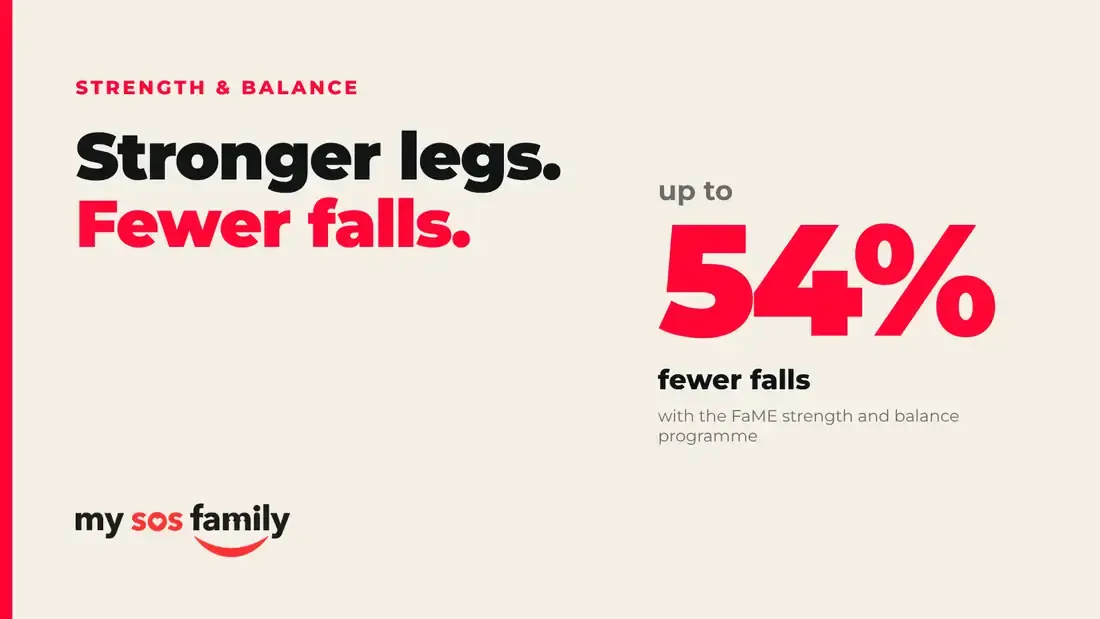
FaME is a group programme that usually runs for six months, with a weekly class led by a trained instructor plus exercises to do at home. It is designed for older people at risk of falls. Studies show it can reduce falls by between 26% and 54%, and more than 10,000 people across the UK take part every week. It also teaches people how to get up from the floor, which helps prevent a long lie if a fall does happen.
Otago Exercise Programme
The Otago programme is done at home. A physiotherapist or trained instructor sets tailored leg-strengthening and balance exercises, often with ankle weights, and checks progress. It is a good choice for people who can't get to a class.
Other options
Many areas also offer strength and balance classes run by councils, leisure centres, Age UK and other charities, as well as seated exercise for people who can't stand for long.
How to find a strength and balance class
Ask the GP, practice nurse or physiotherapist for a referral to a local falls prevention or strength and balance programme.
Contact the local falls service if your parent has had a fall. A falls assessment should include exercise.
Check with the council, leisure centre or Age UK for local classes. In some areas people can refer themselves.
Ask about home-based options if getting out is difficult.
Simple exercises to talk about with the GP or physio
These are common, gentle strength and balance exercises. Check with a GP or physiotherapist first, especially if your parent has fallen, feels dizzy or has a health condition. Always use a sturdy chair or kitchen worktop for support.
Sit to stand: stand up from a firm chair and sit down slowly, using hands only if needed.
Heel raises: holding the worktop, rise up onto the toes, then lower slowly.
Toe raises: holding the worktop, lift the toes off the floor, then lower.
Side leg lifts: holding the worktop, lift one leg out to the side and back.
Heel-to-toe standing: holding the worktop, stand with one foot directly in front of the other.
One-leg standing: holding the worktop, stand on one leg for a few seconds, then swap.
How families can help them keep going
The biggest challenge is sticking with it. Benefits build over months, not days.
Go together to the first class, or do the home exercises with them.
Make it social: classes are a great way to meet people.
Track progress: note how many sit-to-stands they can do each week.
Celebrate small wins, such as walking to the shops again.
Keep going after a wobble or a fall. Stopping exercise after a fall often makes the next fall more likely.
How My SOS Family helps them stay active
Fear of falling keeps many older people indoors, which makes them weaker. Knowing help is always close can give them the confidence to stay active.
One press reaches the whole family. The My SOS Family app calls, texts and emails chosen contacts at the same time, with their location.
Help on the wrist or by voice. Works on Apple Watch and Android smartwatches. With Amazon Alexa, just say "Alexa, open My SOS Family". On a basic or big-button phone, use speed dial.
Safer walks. Share live location with family on a walk or a trip to a class.
Daily check-ins. If a check-in is missed, the family is told, so a fall is found in hours, not days.
Start free today. Every feature free for 14 days, with no card needed and 5 full SOS activations. After the trial, free email and notification alerts carry on, so there is nothing to remember to cancel. It's ideal for someone just discharged from hospital. Download My SOS Family
For GPs, physios, councils and falls services: no cost to your service
Because the 14-day trial is free and needs no card, health and care services can recommend My SOS Family at no cost to the NHS, the council or the public purse. There is no contract, no equipment to install and no call centre to fund. A physiotherapist, falls team, exercise instructor, social worker or GP can simply point a patient or family to the app, and family members become the responders.
After the trial, free email and notification alerts carry on, so nobody is left without a way to raise the alarm.
My SOS Family is a family safety tool, not a medical service. In a life-threatening emergency, always call your emergency number: 999 in the UK, 911 in the US or 000 in Australia.
Frequently asked questions about strength and balance
What are the best exercises to prevent falls in older people?
Exercises that challenge balance while standing and build leg strength, done regularly and made harder over time. Structured programmes like FaME and Otago have the best evidence.
How often should older people do strength and balance exercises?
At least two days a week, alongside being active every day, according to UK guidelines.
Is it too late to start strength training at 80 or 90?
No. Strength and balance can improve at any age. Start gently, with advice from a GP or physiotherapist.
How long does a falls prevention programme last?
Most effective programmes run for around six months. FaME, for example, is a six-month programme.
Is Tai Chi good for balance?
Yes. Tai Chi is a good balance activity and is recommended in UK guidelines, alongside dancing and bowls.
Related reading
Long Lie After a Fall: Why Every Minute on the Floor Matters
Falls Risk Assessment (FRAT): What It Means for Your Mum or Dad, and What to Do Next
Structured Medication Review: How to Ask for One for Your Mum or Dad
Frailty Score Explained: What Mild, Moderate or Severe Frailty Means for Your Mum or Dad
Proactive Frailty Care: Finding Older People at Risk Before the Crisis
Sources
UK Chief Medical Officers' physical activity guidelines – GOV.UK
Physical activity for adults and older adults (infographic text) – GOV.UK
Empowering older adults through exercise (FaME) – NIHR ARC East Midlands
The FLEXI study – University of Nottingham
Reducing falls among older people in general practice: ProAct65+ – University of Nottingham
ProAct65+ trial – British Journal of General Practice


